
TL;DR:
- A Wisconsin land contract is a seller-financing agreement where the buyer holds equitable title until full payment. Recording the contract protects buyers from third-party claims, and balloon payments require careful planning. Buyers must handle taxes, insurance, and property maintenance from the start, with short default cure periods heightening risks.
A Wisconsin land contract is a legally binding seller-financing agreement where the buyer holds equitable title while making installment payments directly to the seller, who retains legal title until full payment. This arrangement, also called a contract for deed, gives buyers a path to property ownership without a traditional bank loan. Contracts typically span 5–10 years and end with a balloon payment. Understanding what is a land contract in Wisconsin means knowing both its real benefits and its serious legal risks before you sign anything.
What is a land contract in Wisconsin and how does it work?
A land contract is a seller-financing tool where the seller acts as the lender. The buyer moves in, makes monthly payments, and builds equity. The seller keeps the deed until the buyer pays off the agreed purchase price, usually through a balloon payment at contract end. That balloon payment typically comes due after 5–10 years, far shorter than a standard 15 or 30-year mortgage.

The buyer holds equitable title during the contract period. Equitable title means the buyer has a legal interest in the property and the right to occupy it, but not the deed itself. The seller holds legal title as security until the final dollar is paid. This split-title structure is the defining feature of every land contract in Wisconsin.
Land contracts work well in specific situations. A seller who owns property free and clear can offer financing to a buyer who cannot yet qualify for a conventional loan. Developers also use them to manage capital and tax timing, making them more than just a last-resort option for struggling buyers. Land contracts serve both financing and conveyance purposes, which is exactly why precise drafting matters so much.
What are the legal requirements for a Wisconsin land contract?
Wisconsin law sets clear rules for land contracts. A contract that skips any of these requirements risks being unenforceable.
Required elements under Wisconsin law:
- The contract must be in writing. Verbal land contract agreements are not legally binding under state law.
- The document must state the total purchase price clearly.
- The contract must specify the interest rate applied to the unpaid balance.
- A payment schedule showing amounts and due dates must be included.
- Both buyer and seller must sign the written agreement.
Recording the contract at the county Register of Deeds office is not legally required to make it valid between the two parties. However, failure to record creates serious buyer vulnerabilities. Without a recorded contract, the seller could legally sell the property to a third party or take out a mortgage against it. A buyer in that situation would have little public evidence of their ownership interest.
Pro Tip: Record your land contract at the county Register of Deeds office immediately after signing. This single step protects your equitable interest from third-party claims and costs very little compared to the risk of skipping it.
Drafting errors cause most land contract disputes. Errors in stated interest rates, payment amounts, or default terms can lead to costly litigation. Precise contract drafting is not optional. Both parties should have an attorney review the document before signing.
What are the rights and risks for buyers and sellers?
Both sides carry real responsibilities under a Wisconsin land contract. Knowing them upfront prevents expensive surprises.
Buyer responsibilities from day one of possession:
- Pay property taxes on time, even though the deed is still in the seller’s name.
- Carry homeowner’s insurance and keep the policy current throughout the contract term.
- Maintain the property and cover all repairs, including major systems like the roof or furnace.
- Make installment payments on schedule to avoid default and potential loss of the property.
Buyers assume full financial responsibility for property upkeep from the moment they take possession. That means a buyer could spend thousands on repairs before ever receiving the deed. This is a significant difference from renting, where the landlord covers most maintenance costs.
Sellers hold a powerful position in a default scenario. Wisconsin law allows sellers to pursue strict foreclosure when a buyer misses payments. Strict foreclosure can move through the courts faster than a traditional mortgage foreclosure. Buyer cure periods can be contractually limited to 15 days, meaning a buyer who falls behind has very little time to catch up before losing the property and all payments made.
Pro Tip: If you are a buyer, negotiate the longest cure period the seller will accept. A 30 or 60-day cure period gives you time to arrange funds if you hit a rough patch, rather than losing everything in two weeks.
Land contracts also lack consumer protections standard in traditional mortgages. No mandatory appraisal is required. No independent inspection is required. The buyer takes on the risk of overpaying for a property or inheriting hidden defects. Independent inspections and legal counsel are not just good ideas. They are necessary.
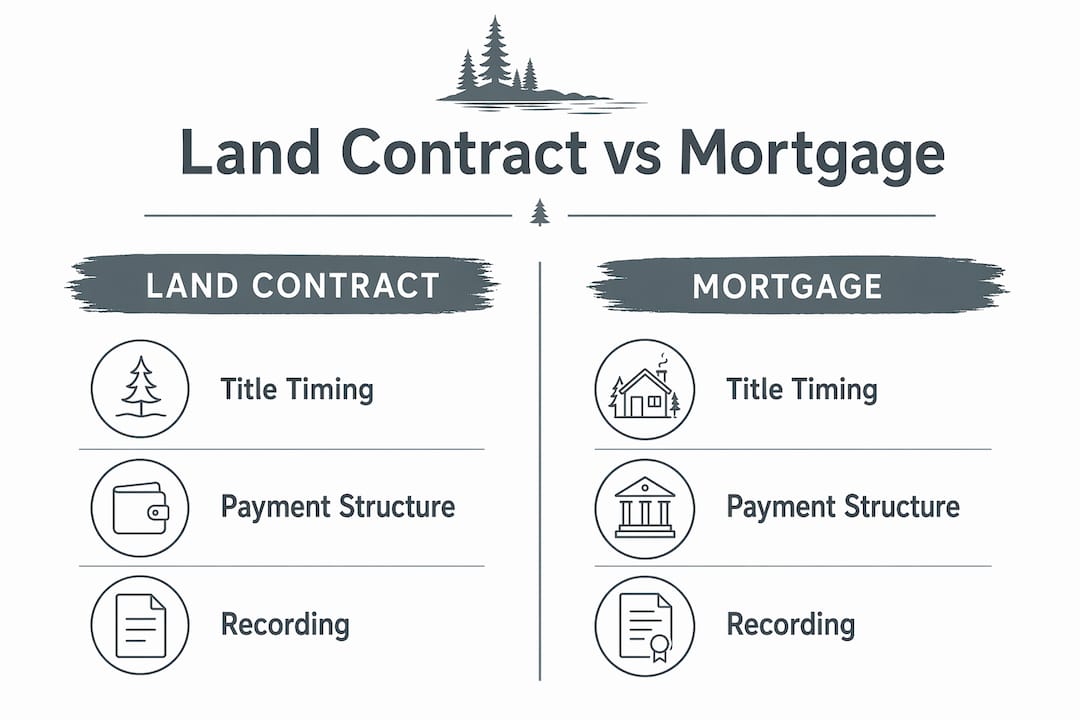
How does a land contract compare to a traditional mortgage in Wisconsin?
The differences between a land contract and a conventional mortgage affect everything from your monthly payment to your legal protections.
| Feature | Land contract | Traditional mortgage |
|---|---|---|
| Title transfer timing | At full payoff, often 5–10 years | At closing, immediately |
| Loan term | Typically 5–10 years | Typically 15–30 years |
| Payment structure | Installments plus balloon payment | Fully amortized, no balloon |
| Credit requirements | Flexible, set by seller | Set by lender, often strict |
| Consumer protections | Minimal, no mandatory appraisal | Extensive federal and state rules |
| Default consequences | Strict foreclosure, short cure periods | Longer foreclosure process |
| Recording requirement | Optional but strongly advised | Mortgage recorded automatically |
The biggest practical difference is title timing. With a mortgage, you receive the deed at closing and own the property from day one. With a land contract, you wait years for that deed. That gap in legal ownership creates real exposure for buyers.
The balloon payment structure also sets land contracts apart. A buyer making payments for seven years still needs to come up with a large lump sum at the end. If they cannot secure a traditional mortgage at that point, they risk losing the property and all the equity they built. Balloon payment requirements make land contracts a short-term bridge, not a long-term solution.
Land contracts do offer real advantages for buyers who cannot yet qualify for conventional financing. The seller sets the credit standards, which can be far more flexible than a bank’s underwriting rules. For buyers building credit or recovering from financial setbacks, this access matters.
How do you create and manage a land contract in Wisconsin?
Creating a legally sound land contract takes more than downloading a template. Each step below protects both parties and reduces the chance of future disputes.
- Hire a real estate attorney before drafting anything. An attorney familiar with Wisconsin land contract laws will catch terms that could become problems later, such as vague default definitions or missing interest rate disclosures.
- Draft the contract with all required terms. Include the full purchase price, interest rate, payment schedule, balloon payment date, default remedies, and cure periods. Vague language invites disputes.
- Order an independent property inspection. No law requires it, but skipping it shifts all risk to the buyer. A professional inspection reveals defects that affect the property’s true value.
- Negotiate terms before signing. Buyers should push for longer cure periods, clear maintenance responsibilities, and a defined process for title transfer. Sellers should specify exactly what constitutes default.
- Record the contract at the county Register of Deeds. Do this immediately after signing. Recording protects the buyer’s equitable interest from third-party claims and establishes a public record of the agreement.
- Plan for the balloon payment early. Buyers should start building their credit and savings well before the balloon comes due. Connecting with a mortgage lender two or three years before the end of the contract term gives you time to qualify for refinancing.
- Keep detailed payment records. Both parties should document every payment made, including date, amount, and running balance. Disputes over payoff amounts are common and records resolve them quickly.
You can find additional context on how land trust properties are sold in Wisconsin, which shares legal enforcement considerations relevant to land contract buyers and sellers in the region.
Key Takeaways
A Wisconsin land contract gives buyers property access without a bank loan, but the split-title structure, balloon payment requirement, and limited consumer protections make legal preparation and recording non-negotiable for both parties.
| Point | Details |
|---|---|
| Definition and title split | Buyers hold equitable title; sellers keep legal title until full payment is complete. |
| Recording protects buyers | Record the contract at the county Register of Deeds immediately to prevent third-party claims. |
| Balloon payment planning | Contracts end in 5–10 years with a lump-sum payment; buyers must plan for refinancing early. |
| Buyer responsibilities start at possession | Taxes, insurance, and all maintenance fall on the buyer from day one, before the deed transfers. |
| Default risk is severe | Strict foreclosure cure periods can be as short as 15 days, leaving little time to recover from missed payments. |
My honest read on land contracts as a financing tool
Land contracts get a bad reputation in some circles, and honestly, part of that reputation is earned. I have seen buyers lose years of payments because they skipped the recording step or signed a contract with a 15-day cure period they did not fully understand. Those outcomes are avoidable, and they happen because people treat land contracts like informal handshake deals instead of the serious legal instruments they are.
That said, I think land contracts are genuinely useful when used correctly. For a buyer who is two years away from qualifying for a conventional mortgage, a well-drafted land contract with a fair seller can be the bridge that gets them into a property they could not otherwise access. The key word is “well-drafted.” A contract without a recorded interest, without a defined default process, or without an independent inspection is a liability, not an opportunity.
The buyers I have seen succeed with land contracts share one habit: they treat the contract period as preparation time. They build credit, save for the balloon payment, and stay in contact with a mortgage lender throughout the term. The buyers who struggle treat the land contract as the finish line instead of a starting point.
If you are considering northern Wisconsin real estate through a land contract, get an attorney involved before you sign. The cost of a legal review is small compared to the cost of a dispute or a lost property. Do not let the informal nature of seller financing make you less careful than you would be with a bank loan.
— Chris
Northern Wisconsin property and lodging worth knowing about
If your interest in Wisconsin real estate extends beyond financing mechanics and into actually spending time in the region, Northwoodswisconsin is the place to start. The site covers lodging, recreation, and local property opportunities across Northern Wisconsin’s lake country, with access to information on over 3,200 lakes and miles of forested land.

Whether you are scouting the area before a purchase or just looking for a base camp while you explore, options like Stepaway Vacation Rentals put you right in the heart of the Northwoods. Northwoodswisconsin curates lodging and recreation listings so you can focus on the experience rather than the research. Visit the site to find cabins, resorts, and recreation guides built for people who take Northern Wisconsin seriously.
FAQ
What is the land contract definition in Wisconsin?
A Wisconsin land contract is a seller-financing agreement where the buyer makes installment payments directly to the seller and holds equitable title, while the seller retains legal title until the full purchase price is paid.
Does a Wisconsin land contract need to be recorded?
Recording is not legally required for the contract to be valid between the two parties, but failure to record leaves buyers exposed to the seller selling or mortgaging the property to a third party.
What happens if a buyer defaults on a Wisconsin land contract?
The seller can pursue strict foreclosure through the courts, and cure periods can be as short as 15 days if specified in the contract, which is far shorter than traditional mortgage foreclosure timelines.
How is a land contract different from a mortgage in Wisconsin?
With a mortgage, the buyer receives the deed at closing. With a land contract, the buyer waits until full payment is complete, often 5–10 years, and must handle a balloon payment to finalize the purchase.
What are the buyer rights under a Wisconsin land contract?
Buyers hold equitable title, have the right to occupy the property, and can enforce the contract terms in court. However, buyers lack consumer protections standard in traditional mortgages, including mandatory appraisals and inspections.
Recommended
