
TL;DR:
- Wisconsin lake property owners must comply with both state and local regulations to obtain proper dock permits. Proper understanding of riparian ownership, the Ordinary High Water Mark, and permit thresholds helps prevent costly violations. Coordinating DNR applications with county zoning ensures legal and safe dock installation.
Dock permits on Wisconsin lakes are governed by Wisconsin DNR thresholds, local shoreland ordinances, and property ownership distinctions that determine which structures need formal approval. Most property owners are surprised to learn that understanding how dock permits work on Wisconsin lakes starts with two separate regulatory layers: state rules from the Wisconsin Department of Natural Resources and local county or municipal shoreland zoning codes. Both must be satisfied before you install anything. Riparian ownership, the legal term for owning land that directly borders a navigable waterway, determines your basic right to place a pier at all. Get this foundation right, and the rest of the process becomes much clearer.
How do dock permits work on wisconsin lakes?
Wisconsin dock permit requirements follow a tiered system. The Wisconsin DNR divides structures into two categories: those covered by a general permit exemption and those requiring an individual permit. Knowing which category your dock falls into saves you time, money, and legal headaches.
Most simple residential seasonal piers do not require a DNR permit if they meet specific design standards and size limits. That means the typical floating or pipe dock you pull out each fall likely qualifies for an exemption, provided it stays within the thresholds below.
Docks that qualify for a general permit exemption
These structures typically fall under the exemption:
- Seasonal residential piers that are removed each fall and reinstalled each spring
- Docks with a single boat slip and no large platform attached
- Structures that do not obstruct navigation or interfere with neighboring riparian rights
- Piers built with open-grate or non-solid decking that allows light penetration
- Docks that stay within your property’s frontage width
Docks that require an individual DNR permit
More complex structures trigger the individual permit process:
- Docks projecting more than 100 feet from the ordinary high water mark
- Structures with large platforms, covered boat lifts, or enclosed slips
- Multi-slip docks, where slip caps typically range from 3–10 depending on frontage and location
- Permanent or year-round structures anchored to the lakebed
- Any dock that significantly alters the shoreline or aquatic habitat
Pro Tip: The Wisconsin DNR offers a free Pier Planner tool that walks you through dimensions and placement to confirm whether your design qualifies for an exemption before you build.
How do local shoreland zoning rules affect your dock?
State exemptions do not override local rules. Counties and municipalities layer their own shoreland zoning ordinances on top of DNR requirements, and noncompliance with local rules leads to fines and mandatory dock removal even when your structure meets state standards. This is one of the most common and costly mistakes Wisconsin lake property owners make.
Local ordinances typically address four areas:
- Setbacks from property lines. Most counties require a minimum lateral setback, often 10–15 feet from the extended property line, to protect neighboring riparian rights. Vilas County and Oneida County both enforce setback rules that differ from neighboring jurisdictions.
- Maximum pier size and slip limits. Local shoreland ordinances often cap slip numbers per frontage length and restrict total dock square footage. A 100-foot frontage lot may be limited to two slips regardless of what the DNR allows.
- Materials restrictions. Some counties prohibit treated lumber containing certain preservatives near the water. Composite decking or aluminum framing may be required on sensitive lakes.
- HOA and subdivision rules. Private lake associations sometimes impose stricter limits than the county. Ignoring HOA rules can result in fines or forced removal independent of any government action.
Pro Tip: Call your county zoning office before you finalize any dock design. Ask specifically about setback requirements, slip limits, and any material restrictions. A 15-minute phone call can prevent a $5,000 mistake.
How lake classification affects property use also plays a role here. Lakes classified as “outstanding resource waters” or “sensitive” carry stricter local and state controls on dock size and placement.

What is the ordinary high water mark and why does it matter?
The Ordinary High Water Mark, commonly abbreviated as OHWM, is the legal boundary separating your private upland property from the public lakebed controlled by the state of Wisconsin. The OHWM determines public trust lands and directly affects dock permit jurisdiction and your riparian rights. Your property ownership ends at the OHWM. Everything lakeward of that line belongs to the public trust.
This matters for dock permitting in a direct way. Any structure you place beyond the OHWM sits on state-owned lakebed, which is why the DNR has authority over dock placement at all. Wisconsin’s Public Trust Doctrine preserves the lakebed for public use, and that doctrine limits how far and how large your dock can extend.
“Ignoring the Ordinary High Water Mark is the chief regulatory mistake by riparian property owners.” — Lake Geneva Riparian Rights and Pier Understanding
Here is what you need to know about the OHWM in practice:
- The OHWM is typically marked by a change in vegetation, soil type, or visible water line on the bank
- You measure dock length starting from the OHWM, not from your house or the top of the bank
- A surveyor or the Wisconsin DNR can help you locate the OHWM on your specific parcel
- Dock length limits in permit applications are always calculated from the OHWM outward
One more critical point: only riparian owners may place piers. If your deed grants only a lake access easement rather than direct shoreline ownership, you almost certainly cannot build a private pier. Prospective buyers frequently assume lake access equals the right to dock a boat. That assumption is legally incorrect in most cases. Review your deed language carefully before purchasing any lake property with dock plans in mind.
How do you apply for dock permits in wisconsin?
The permit application process for Wisconsin waterfront permits is straightforward once you know the steps. The key is coordinating state and local approvals at the same time rather than treating them as separate projects.
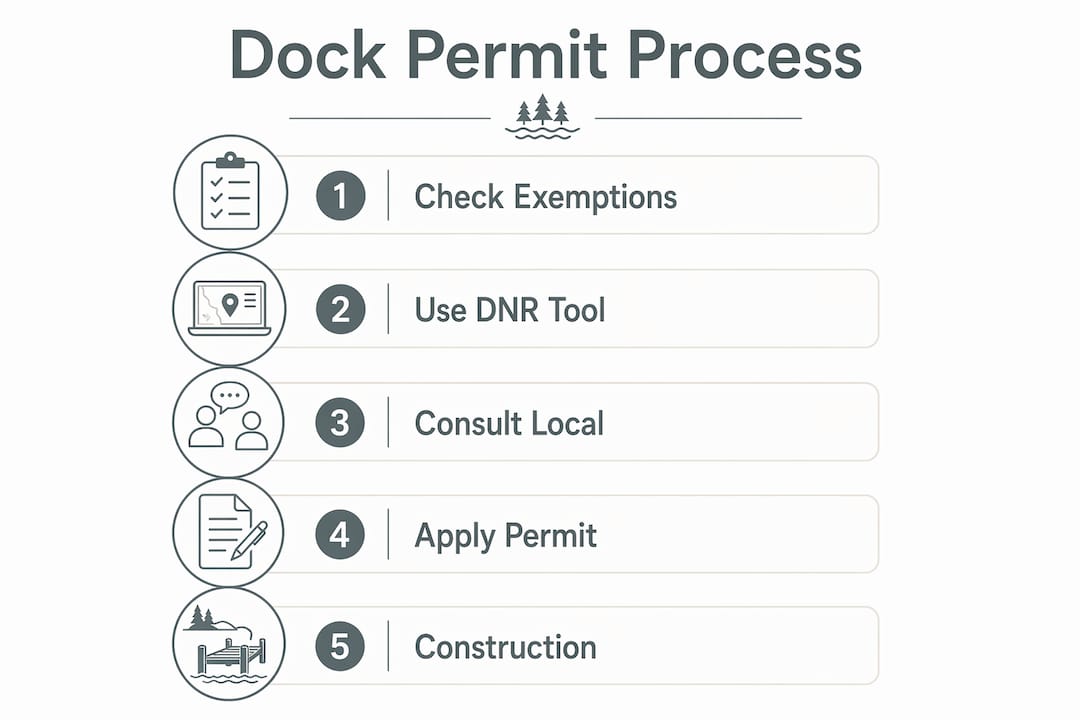
- Check your deed first. Confirm you hold riparian ownership, not just a lake access easement. Without clear deed language granting riparian ownership, you may not have the legal right to build a pier at all.
- Use the DNR Pier Planner. The Pier Planner tool helps you design a dock that meets general permit exemption criteria. Run your dimensions through it before ordering materials.
- Contact your county zoning office. Request the current shoreland zoning rules for your specific lake and parcel. Ask about setbacks, slip limits, materials, and any local permit forms you need to submit.
- Submit your DNR individual permit application if required. If your dock exceeds exemption thresholds, download the individual permit application from the Wisconsin DNR Waterways Program. Include site plans, dimensions, and photos of the shoreline.
- Coordinate with your HOA or lake association. If your subdivision has a lake association, submit your plans for review before construction begins. HOA approval is separate from government permits.
- Factor in environmental conditions. Water level fluctuations and soft lake bottoms in Wisconsin affect dock design and long-term durability. Build in seasonal water level variation so your dock does not become a compliance problem after a wet spring.
Pro Tip: Early consultation with the DNR and local shoreland authorities reduces costly surprises. Request a pre-application meeting with your county zoning administrator if your project is complex or your property rights are unclear.
Unpermitted structures may need removal and full restoration of the shoreline, with substantial financial consequences. The cost of a permit application is always less than the cost of a removal order.
Key takeaways
Wisconsin dock permit compliance requires satisfying both DNR state standards and local shoreland zoning rules before any structure goes in the water.
| Point | Details |
|---|---|
| State exemptions have limits | Simple seasonal piers often qualify for DNR exemptions, but docks over 100 feet or with multiple slips need individual permits. |
| Local rules add another layer | County and municipal shoreland ordinances set setbacks, slip caps, and materials rules that apply even when state exemptions are met. |
| OHWM defines your boundary | Your property ends at the Ordinary High Water Mark; dock length is measured from that line, not from your house. |
| Riparian ownership is required | Lake access easements do not grant the right to build a private pier; only true riparian ownership does. |
| Apply to both state and local | Submit DNR applications and county zoning requests at the same time to avoid construction delays. |
What i have learned about dock permits the hard way
I have talked with a lot of lake property owners across Northern Wisconsin over the years, and the pattern is almost always the same. Someone buys a beautiful lot on a Vilas County lake, assumes the dock that was there before is fine to rebuild, and skips the permit research entirely. Then the county sends a letter.
The honest truth is that Wisconsin’s dock permit system is not designed to be punitive. The DNR and most county zoning offices genuinely want to help you get it right. The problem is that most people do not call until after something goes wrong. A 20-minute conversation with your county zoning administrator before you buy lumber will tell you everything you need to know.
The OHWM issue trips up even experienced property owners. I have seen people measure their dock from the water’s edge on a calm summer day, not realizing the legal boundary sits several feet up the bank. That small measurement error can push a dock into individual permit territory without the owner ever knowing.
My strongest advice: treat the deed review and the county zoning call as non-negotiable first steps, not afterthoughts. If your project involves multiple slips, a large platform, or any uncertainty about property boundaries, hire a Wisconsin-licensed surveyor and consult a real estate attorney who specializes in riparian law. The upfront cost is small compared to a removal order.
— Chris
Plan your wisconsin lake experience with Northwoodswisconsin
Whether you are managing a lakefront property or planning your first trip to the Northwoods, Northwoodswisconsin is your go-to resource for Wisconsin lake living and recreation.

Northwoodswisconsin covers everything from Northern Wisconsin lodging options to lake-specific recreation guides across more than 3,200 lakes in the region. If you want a lakefront stay while you scout your property or meet with local contractors, check out Idle Hours Resort in St. Germain for a comfortable base on the water. For cabin rentals with direct lake access, Anchor Rentals offers well-positioned properties in the heart of the Northwoods. Northwoodswisconsin also connects you with local recreation guides and area insights that help you get the most out of every season on the water.
FAQ
Do i need a permit for a dock in wisconsin?
Most simple seasonal residential piers do not require a Wisconsin DNR permit if they meet design and size standards. Docks exceeding 100 feet, multi-slip structures, or permanent installations require an individual DNR permit.
What is the ordinary high water mark in wisconsin?
The Ordinary High Water Mark is the legal boundary between your private upland property and the state-owned lakebed. Dock length is measured from the OHWM outward, and all structures beyond it fall under DNR jurisdiction.
Can i build a dock if i only have lake access rights?
No. Only riparian property owners, those whose deed grants direct shoreline ownership, may legally place a private pier. Lake access easements rarely include the right to build a dock.
How do i apply for a dock permit in wisconsin?
Start with the Wisconsin DNR Pier Planner tool to check if your design qualifies for an exemption. If an individual permit is required, submit an application through the Wisconsin DNR Waterways Program and simultaneously contact your county zoning office for local approvals.
What happens if i build a dock without a permit in wisconsin?
Unpermitted structures can trigger removal orders and shoreline restoration requirements, along with significant fines from both the DNR and local authorities. The cost of compliance after the fact almost always exceeds the cost of getting permits upfront.
Recommended
