
TL;DR:
- Lakefront property values are primarily driven by shoreline frontage, water access, and ecological quality, not home size.
- These assets command premiums up to 116% over inland homes due to their inherent scarcity and fixed shoreline limits, making valuation highly site-specific.
Lakefront property values differ primarily because of shoreline frontage length, navigable water access, and lake ecosystem quality, not home size or neighborhood comps. Zillow research documents waterfront premiums reaching 116% over comparable inland homes in high-demand U.S. markets. These premiums exist because shoreline is finite. No new lakefront can be manufactured, which creates a structural scarcity that separates this real estate category from every other. If you are evaluating lakefront property investment in the Northwoods or anywhere in the Upper Midwest, understanding these specific valuation drivers will save you from costly misjudgments.
Why lakefront property values differ from inland homes
Lakefront real estate valuation inverts the standard appraisal hierarchy. In traditional residential markets, square footage, bedroom count, and neighborhood sales drive price. For lakefront properties, frontage length is primary, followed by view quality and shoreline condition. Home size ranks last. This is not a regional quirk. It applies across Minnesota, Michigan, and Wisconsin lakefront markets consistently.
The scarcity logic is straightforward. A developer can build more bedrooms, but nobody can extend a lake’s shoreline. That physical constraint creates a price floor that holds through downturns in ways inland housing cannot match. Luxury lakefront sales above $5 million show 65% cash transactions as of 2026, which means these markets are largely insulated from interest rate cycles that shake conventional housing demand.
Automated valuation models from platforms like Zillow or Redfin routinely undervalue or misvalue lakefront homes because they rely on price-per-square-foot metrics. Those metrics simply do not capture site-specific factors like view orientation, water depth at the dock, or shoreline vegetation. Investors who rely on automated estimates without a specialized lakefront appraisal are working with incomplete data.
How shoreline frontage drives lakefront property prices
Frontage is the single most powerful pricing variable in lakefront real estate. In North Central Minnesota and the Nisswa area, a 100-foot lake lot routinely commands more value than a new 3,000 square foot inland home. That comparison surprises many first-time lakefront buyers, but it reflects how buyers actually compete for these properties. More frontage means more privacy, better dock placement options, and wider unobstructed views.

Appraisers working in lakefront markets use paired-sales analysis to isolate the frontage variable. This method compares two similar lake properties that differ primarily in frontage length, then calculates a per-linear-foot adjustment. Paired-sales analysis is the standard tool in Minnesota and Michigan lakefront markets precisely because standard square-footage adjustments produce misleading results. Without it, you cannot accurately compare a 75-foot lot to a 150-foot lot on the same lake.
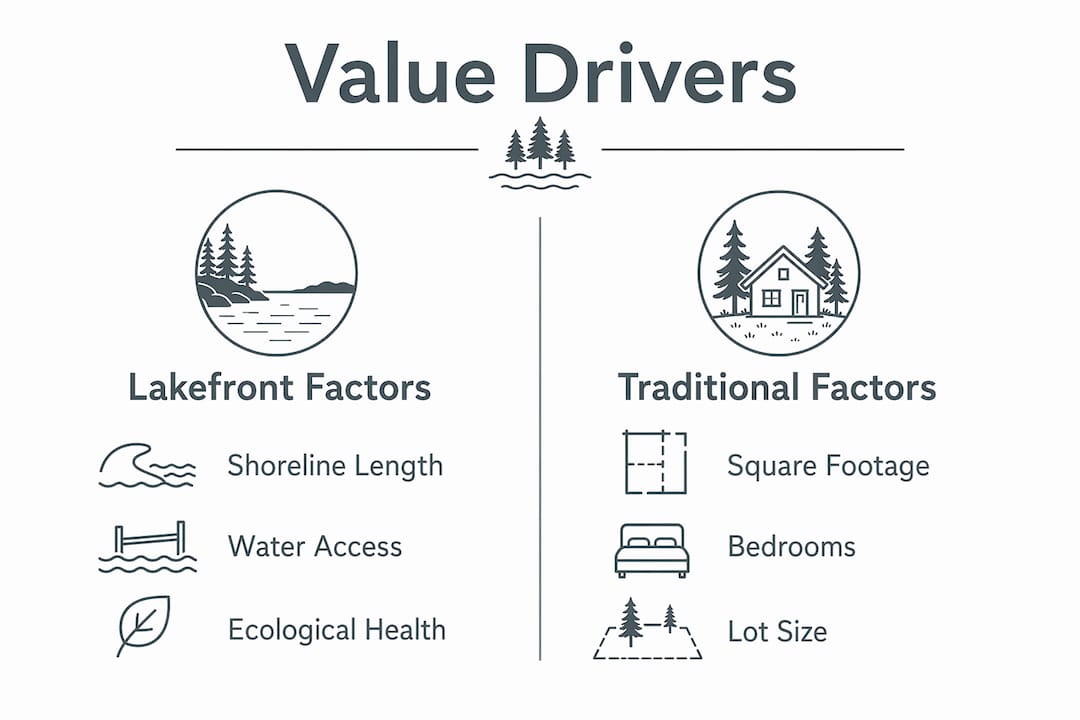
Here is how the valuation hierarchy compares across property types:
| Factor | Traditional home valuation | Lakefront valuation |
|---|---|---|
| Square footage | Primary driver | Low priority |
| Bedroom/bathroom count | High priority | Secondary |
| Shoreline frontage | Not applicable | Primary driver |
| View quality | Minor factor | High priority |
| Lot size | Moderate factor | Secondary to frontage |
| Neighborhood comps | Primary benchmark | Unreliable without frontage adjustment |
Pro Tip: When evaluating any lakefront listing, calculate the price per linear foot of frontage, not price per square foot of living space. That single metric gives you a far more accurate read on whether a property is priced fairly relative to comparable lots on the same lake.
What water access and dock features add to property value
Water utility in lakefront real estate means navigable boat access combined with permitted dock structures. These two features together can add at least $100,000 in value over a lakefront property with restricted or non-navigable access. An appraisal study out of St. Petersburg, Florida confirmed this premium, and regional Wisconsin and Minnesota markets reflect the same pattern.
Understanding what lakefront access means for buyers goes beyond simply having a dock. The type of access, its legal standing, and the recreational possibilities it creates all factor into the final price. Here is how different access types typically rank by value contribution:
- Deeded private frontage with permitted dock: Highest value. Full navigable access, legal dock structure, no shared use restrictions.
- Shared frontage with association dock rights: Moderate value. Access exists but is diluted by shared use and association rules.
- Riparian rights without dock permit: Lower value. Legal water rights exist, but permitting gaps create uncertainty and added cost.
- Easement-only access: Minimal premium. No direct ownership of shoreline; access can be restricted or revoked.
- Non-navigable or seasonal water access: Little to no premium over inland pricing.
Unpermitted docks are a significant red flag in any lakefront transaction. Municipalities in Wisconsin, Minnesota, and Michigan have tightened enforcement on dock permitting, and an unpermitted structure can trigger removal orders, fines, and title complications. That uncertainty gets priced in immediately during buyer due diligence.
Pro Tip: Always request the dock permit history and current municipal compliance status before making an offer on any lakefront property. A dock that looks permanent may have no legal standing, and that gap can cost far more than the purchase price difference suggests.
How environmental and ecological factors affect lake property values
Shoreline ecology is a direct pricing variable, not a secondary concern. Stable, vegetated natural shorelines add measurable value, while armored seawalls and eroded banks reduce desirability and create regulatory complications. Environmental consultants working in Wisconsin and Minnesota consistently flag vegetated slopes as green indicators and seawalls as potential liabilities. The reason is practical: seawalls often signal underlying erosion problems, and they complicate future permitting.
Properties on lakes with stable water levels and healthy ecosystems appreciate better over time and carry lower insurance risk. Spring-fed lakes in Northern Wisconsin, for example, maintain more consistent water levels through drought cycles than lakes dependent entirely on surface runoff. That stability translates directly into long-term investment quality. A lake that drops two feet every dry summer creates dock access problems, aesthetic issues, and buyer hesitation.
Here is a practical reference for evaluating ecological conditions before purchase:
| Indicator | Green flag | Red flag |
|---|---|---|
| Shoreline vegetation | Native plants, stable slope | Bare soil, invasive species |
| Water level consistency | Spring-fed, stable year-round | Seasonal fluctuation, drought sensitivity |
| Shoreline structures | Natural bank, no armoring | Seawalls, riprap with erosion signs |
| Water clarity | Clear, low algae | Algae blooms, turbid water |
| Regulatory compliance | Clean permit history | Violations, pending orders |
Environmental regulations in Wisconsin and Minnesota also affect what you can build or modify on a shoreline. Properties with clean compliance histories face fewer obstacles when owners want to add a boathouse, expand a dock, or restore vegetation. Lake water quality directly shapes both the regulatory environment and the buyer pool, since health-conscious buyers increasingly prioritize swim-safe, algae-free water.
Pro Tip: Request the lake’s DNR classification and any recent water quality reports before closing. Wisconsin’s Department of Natural Resources maintains public records on lake health, invasive species status, and shoreline regulation tiers. That data takes 20 minutes to pull and can change your entire valuation picture.
How scarcity and local regulations shape lakefront prices
Lakefront supply is structurally limited in ways that no market cycle can reverse. Lake Michigan’s shoreline, for example, is constrained by zoning, geography, and conservation policies that prevent new waterfront subdivision. The same dynamic applies across Northern Wisconsin, where Oneida County and Vilas County shorelines are governed by low-density zoning and conservation easements that cap the number of buildable lakefront parcels permanently.
This supply ceiling creates pricing behavior unlike any other residential segment. When broader housing markets soften, lakefront properties in high-demand Northwoods regions hold value more reliably because the supply side never expands to absorb demand. You cannot build your way out of a lakefront shortage. That is the core reason why lakefront scarcity is permanent and why entry prices remain elevated even during rate-driven slowdowns.
Regulatory factors add another layer of complexity for investors. Conservation easements, shoreline buffer requirements, and building setback rules vary by county and lake classification. Some lakes in Northern Wisconsin carry stricter protections than others, which limits what future owners can develop. Those restrictions reduce flexibility but also protect the ecological conditions that sustain value. Investors who treat regulatory constraints as purely negative miss the point: those same rules prevent the overdevelopment that degrades lake quality and erodes prices over time.
Key supply constraints to evaluate before any lakefront purchase:
- Zoning classification and minimum lot size requirements for the specific lake
- Active conservation easements on the parcel or adjacent shoreline
- County shoreline buffer ordinances and setback distances
- State DNR shoreline alteration permit requirements
- Any pending rezoning proposals or conservation expansions in the area
Key takeaways
Lakefront property values differ because frontage, water access, and ecological health outweigh every traditional valuation metric, creating a structurally scarce asset class that performs differently from all other residential real estate.
| Point | Details |
|---|---|
| Frontage is the primary value driver | Price per linear foot of shoreline is more meaningful than price per square foot of living space. |
| Water access type determines premium | Deeded frontage with a permitted dock adds the most value; easement-only access adds little. |
| Ecological health affects long-term returns | Spring-fed lakes with stable water levels and vegetated shorelines appreciate more reliably. |
| Scarcity is structural and permanent | Zoning, conservation, and geography prevent new lakefront supply, creating a durable price floor. |
| Specialized appraisal methods are required | Paired-sales analysis with frontage adjustments is the standard for accurate lakefront valuation. |
What I’ve learned about Northwoods lakefront pricing after years in the market
I have watched buyers overpay for lakefront homes with impressive square footage and undervalue modest cabins sitting on 200 feet of pristine frontage. The mistake is consistent: people apply inland real estate logic to a market that operates by completely different rules. A 4,000 square foot home on 60 feet of weedy shoreline is a worse investment than a 1,200 square foot cabin on 180 feet of clean, spring-fed water. Every time.
The appraisal gap is real and it matters. General residential appraisers working in Northwoods markets sometimes miss the nuances of frontage adjustments, view premiums, and dock permit status. I always recommend working with appraisers who specialize in lakefront properties and have direct experience with Wisconsin or Minnesota lake markets. The difference in accuracy is not small.
Climate resiliency is becoming a pricing factor that most buyers still underweight. Lakes with stable, spring-fed water levels and healthy shoreline ecology are going to outperform weather-sensitive lakes as drought cycles become more frequent. That is not speculation. It is already showing up in how quickly certain Northwoods properties move compared to others on less resilient water bodies.
My honest advice for investors: spend more time evaluating the lake than the house. The structure can be renovated. The frontage, the water quality, and the regulatory standing of the shoreline are fixed. Get those right and the investment takes care of itself.
— Chris
Explore Northwoods lakefront properties and lodging
If you are ready to experience what makes Northwoods lakefront properties worth the premium, there is no better starting point than getting on the water yourself.
The Lodge at Crooked Lake offers premier lakefront access in the heart of Northern Wisconsin, giving you a firsthand look at the shoreline quality, water access, and natural setting that drive real value in this market. Northwoodswisconsin also curates a full range of Northern Wisconsin recreation options across more than 3,200 lakes, so you can evaluate the region’s lifestyle appeal alongside its investment fundamentals. Whether you are planning a scouting trip or a full vacation, the Northwoodswisconsin guide connects you with the local knowledge that makes lakefront decisions easier and smarter.
FAQ
What is the biggest factor in lakefront property valuation?
Shoreline frontage length is the dominant valuation factor for lakefront properties, exceeding home size in importance. In North Central Minnesota, a 100-foot lake lot can be worth more than a new 3,000 square foot inland home.
How much more do lakefront homes cost than inland homes?
Lakefront properties command premiums between 30% and 116% over comparable inland homes, depending on the market. Zillow research documents the upper end of that range in high-demand U.S. markets as of 2026.
Does a dock add value to a lakefront property?
A permitted dock with navigable water access can add at least $100,000 in value over a lakefront property without dock access. Unpermitted docks reduce value by creating legal and compliance uncertainty.
Why do two lakefront homes on the same lake have different prices?
Differences in frontage length, view orientation, shoreline condition, dock permits, and water depth at the shoreline all create significant price variation between properties on the same lake. Automated valuation models often miss these site-specific differences.
Are lakefront properties a good investment during economic downturns?
Lakefront properties hold value better than most residential real estate during downturns because supply is structurally limited and demand is driven by cash buyers. Luxury lakefront sales above $5 million show 65% cash transactions as of 2026, reducing sensitivity to interest rate increases.
Recommended
